
© Green Green, 2022-2026
Website developed by Anton Vlasov
Most cash receipts are printed on thermal paper — a special paper that darkens when heated and does not require ink. It contains chemical developers, most commonly bisphenol A (BPA) or bisphenol S (BPS). These substances are needed for text to appear, but they easily transfer to the skin when in contact with the receipt.
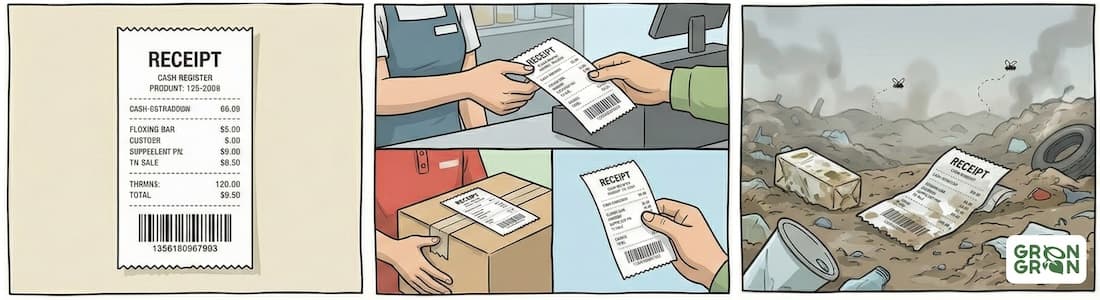
Today, thermal paper is used not only in stores. It is used in ATMs, ticket machines, payment terminals, parking lots, delivery services, pharmacies, cafes, and warehouses. That is, people encounter it almost every day without even thinking about it. Cashiers and couriers especially frequently come into contact with thermal paper, as they constantly hold receipts in their hands.
After use, such receipts almost always end up in the trash. Thermal paper is not suitable for regular paper recycling because the chemicals it contains contaminate recyclable materials.
Previously, collecting receipts as a separate fraction was practiced in a number of ecocenters in Russia, as well as at the Green Green Ecocenter as an experiment. However, acceptance was suspended, as it was not possible to establish stable sales of collected receipts as recyclable materials — recycling thermal paper turned out to be too complex and economically unfeasible under existing conditions.