
© Green Green, 2022-2026
Website developed by Anton Vlasov
Tetra Pak packaging is often perceived as an eco-friendly alternative because it looks like cardboard and seems "paper-like". In fact, tetrapak is a multi-layer composite consisting of paper, plastic, and a thin layer of aluminum. These layers cannot be simply separated from each other, making such packaging extremely difficult to recycle despite its "eco-appearance".
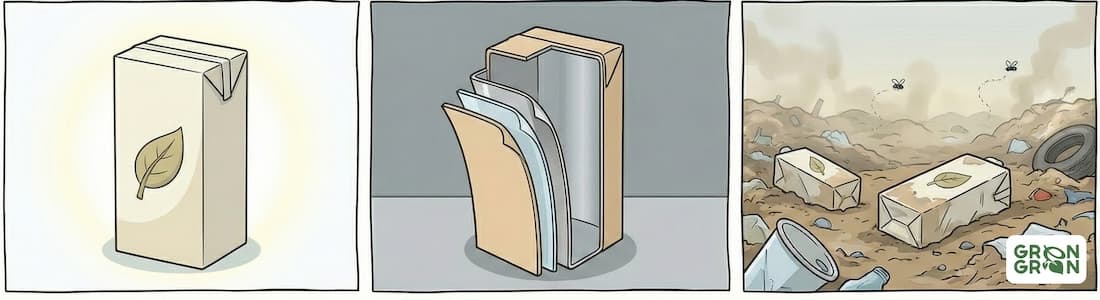
Recycling tetrapak requires special facilities that are virtually non-existent in Armenia. As a result, all tetrapak ends up directly in landfills, where it does not decompose like regular paper due to the presence of plastic and aluminum and can persist in the environment for decades.
Meanwhile, real collection and recycling in Armenia exists for regular plastic — PET (marking 1) and PP (marking 5), as well as for glass, which is one of the most eco-friendly packaging options when returned and reused. Therefore, from a sustainability perspective, returnable glass containers, reusable bottles, and recyclable plastic are more honest alternatives to tetrapak, which looks "eco-friendly" but almost always becomes non-recyclable waste.