
© Green Green, 2022-2026
Website developed by Anton Vlasov
Paper bags are often considered a more eco-friendly alternative to plastic ones because they are made from renewable materials and do decompose better in nature. They do not create microplastics and are easier to recycle. However, it's important to understand that their production is much more resource-intensive: on average, a paper bag requires 4 times more energy and 4–6 times more water than a plastic one.
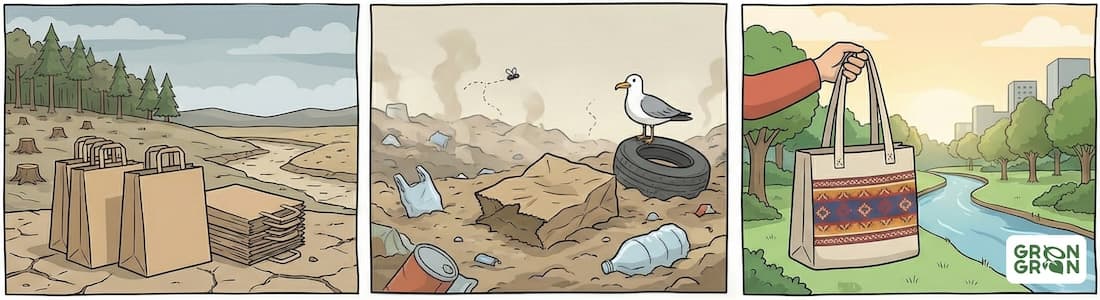
At the same time, Armenia already has serious problems with both forests and water resources. Paper production requires wood and large amounts of water, which means increased consumption of paper bags directly increases the burden on nature. For example: producing about 1,000 paper bags requires approximately 3,800 liters of water, while 1,500 plastic bags — about 220 liters (source). Therefore, if a paper bag is used only once, its actual environmental impact may be even worse than that of regular plastic.
In Armenia, this is especially important because paper bags are most often used once and then end up in landfills. Landfills have almost no oxygen, low humidity, and strong waste compaction — because of this, decomposition processes slow down dramatically. Under such conditions, paper can persist for decades and not decompose significantly faster than plastic. Therefore, paper bags can only be considered as a temporary alternative, and the most eco-friendly option remains reusable bags, which last for years and truly reduce the burden on nature.